 Chinese


18 Aug 2026
Share :
Global Wheat Market Update Aug 10-17, 2026 | AgriGuru Online<h3>🇷🇺 Russia: Export Duty Hike & Black Sea Disruptions</h3><p>Russia's <strong>wheat export duty</strong> has more than doubled, rising from RUB 326.6/t to RUB 721.1/t, effective August 19–25, 2026. Ongoing Black Sea and Azov Sea disruptions — including attacks and export limits — have cut export capacity, with damage reported at Novorossiysk terminals. Larger new-crop domestic availability may pressure farm-gate prices, raising exporters' storage, transport, and financing costs. FOB wheat prices stand near <strong>$220/t</strong> (early September), down $6/t week-on-week, with August export forecasts at approximately 3.1 MMT, though logistics constraints remain a risk.</p><p><br></p><h3>🇰🇿 Kazakhstan: Export Tightening & Regional Focus</h3><p>Kazakhstan's <strong>wheat exports</strong> (ex-EAEU) reached 577,600 t in June 2026, up 7.3% month-on-month but 1.3% lower year-on-year. Marketing year 2025/26 exports for the first 10 months totaled 7.799 Mt, a 17% YoY increase, with nearly 89% of projected export potential already shipped. Regional concentration remains strong, with 77.5% (~6.05 Mt) directed to Central Asia. Standout growth markets include Uzbekistan (+44%), Afghanistan (+165%), Turkey (+2,600%), and Iran (+35,900%), while China-bound shipments fell 83.3% to 23,600 t.</p><p><br></p><h3>🇮🇳 India: DGFT Wheat Export Quota Review</h3><p>India's <strong>DGFT wheat export policy</strong> update requires exporters to submit CA-certified utilization data (for exports up to August 26) along with shipping-bill details by <strong>August 31, 2026</strong>. Under the 50% utilization rule, exporters exceeding 50% may qualify for additional quota, while those below 50% risk reallocation to the common pool unless backed by valid contracts or purchase orders. This signals a tighter, performance-based allocation system favoring active exporters, with unused quota being redistributed — a key development for India's <strong>wheat export market</strong>.</p><p><br></p><h3>🇦🇺 Australia: Wheat Price Rally & Competitiveness Pressure</h3><p>Australian <strong>wheat prices</strong> rallied in July 2026, with APW reaching $289/t (July 31), up $18/t from July 1, peaking at $295/t on July 23. ASW prices climbed to $282/t, up $16/t. This rally has pressured Australia's competitiveness — mid-July ASW (9% protein) was offered near $310/t versus Argentine 11.5% protein wheat at ~$290/t CFR. Feed substitution trends show delivered corn priced at least $20/t cheaper than competing feed wheat. The 2026/27 wheat crop outlook stands at approximately 30 Mt, with generally favorable rainfall, though northern NSW and Queensland remain drier.</p><p><br></p><h3>🇧🇷 Brazil: Wheat Import Surge Amid Supply Deficit</h3><p>Brazil's <strong>wheat imports</strong> surged in early August 2026, totaling 126,200 t at a daily average of 25,240 t/day — up 7.7% YoY from 23,430 t/day. Average import prices rose 4.1% to $241.40/t, pushing daily spend up 12.2% to $6.09 million. With 2026/27 production forecast at just 5.9 Mt, imports could reach ~9 Mt to bridge the gap. The Paraná region faces a notable shortfall, with production of 2.2 Mt against milling demand of 3.85 Mt, pointing to a potential 1.6 Mt deficit.</p><p><br></p><h3>🇰🇪 Kenya: Wheat Import Approval Delays & Cost Pressures</h3><p>Kenya remains heavily import-dependent, sourcing ~95% of its wheat needs, with only 5% produced domestically. C60 import approval delays are raising demurrage, storage, and financing costs, with risk of pass-through to flour and bread prices. Under local procurement rules, millers must prioritize domestic wheat purchases first — the Local Wheat Purchase Programme price has been raised to <strong>KSh 5,100 per 90-kg bag</strong> (up from KSh 4,750), reshaping Kenya's <strong>wheat market dynamics</strong>.</p><p><br></p><h2>📊 Trading Implications & Key Takeaways</h2><ul><li><strong>Monitor:</strong> Origin-price spreads, tender results, and freight/port operations more closely than futures direction alone.</li><li><strong>Importers:</strong> Consider forward cover where crop cuts or freight risks threaten replacement costs; diversify sourcing origins (Australia, Argentina, Black Sea region).</li><li><strong>Exporters:</strong> Prioritize high-demand lanes — Central Asia for Kazakhstan, Argentina competition for Brazil — while watching Australian price premiums against demand destruction.</li><li><strong>Key Risks:</strong> Currency fluctuations, harvest and weather uncertainty (including El Niño effects), and shifting China/North Africa buying patterns.</li></ul>
Description:
🇷🇺 Russia: Export Duty Hike & Black Sea Disruptions
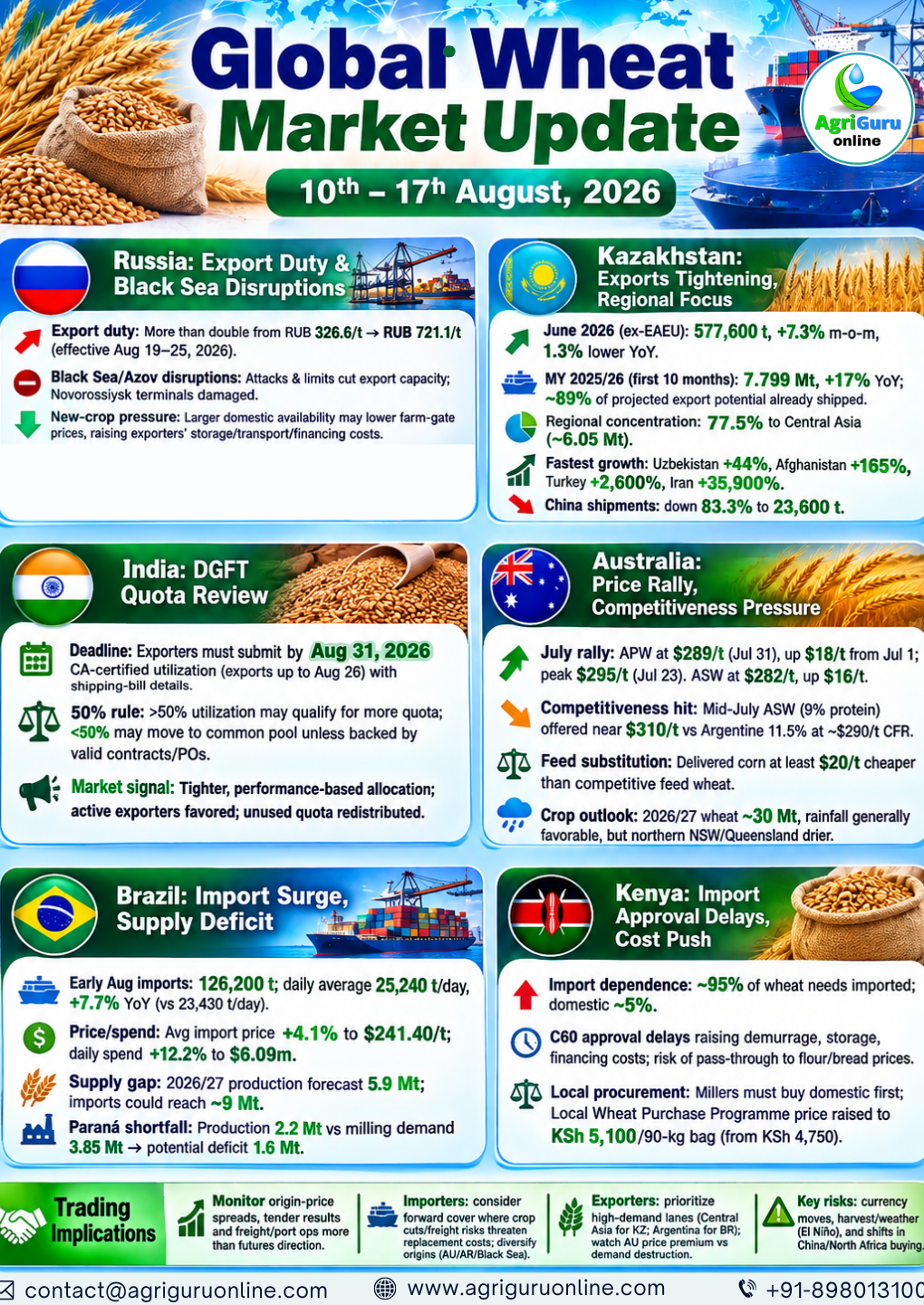
Russia's wheat export duty has more than doubled, rising from RUB 326.6/t to RUB 721.1/t, effective August 19–25, 2026. Ongoing Black Sea and Azov Sea disruptions — including attacks and export limits — have cut export capacity, with damage reported at Novorossiysk terminals. Larger new-crop domestic availability may pressure farm-gate prices, raising exporters' storage, transport, and financing costs. FOB wheat prices stand near $220/t (early September), down $6/t week-on-week, with August export forecasts at approximately 3.1 MMT, though logistics constraints remain a risk.
🇰🇿 Kazakhstan: Export Tightening & Regional Focus
Kazakhstan's wheat exports (ex-EAEU) reached 577,600 t in June 2026, up 7.3% month-on-month but 1.3% lower year-on-year. Marketing year 2025/26 exports for the first 10 months totaled 7.799 Mt, a 17% YoY increase, with nearly 89% of projected export potential already shipped. Regional concentration remains strong, with 77.5% (~6.05 Mt) directed to Central Asia. Standout growth markets include Uzbekistan (+44%), Afghanistan (+165%), Turkey (+2,600%), and Iran (+35,900%), while China-bound shipments fell 83.3% to 23,600 t.
🇮🇳 India: DGFT Wheat Export Quota Review
India's DGFT wheat export policy update requires exporters to submit CA-certified utilization data (for exports up to August 26) along with shipping-bill details by August 31, 2026. Under the 50% utilization rule, exporters exceeding 50% may qualify for additional quota, while those below 50% risk reallocation to the common pool unless backed by valid contracts or purchase orders. This signals a tighter, performance-based allocation system favoring active exporters, with unused quota being redistributed — a key development for India's wheat export market.
🇦🇺 Australia: Wheat Price Rally & Competitiveness Pressure
Australian wheat prices rallied in July 2026, with APW reaching $289/t (July 31), up $18/t from July 1, peaking at $295/t on July 23. ASW prices climbed to $282/t, up $16/t. This rally has pressured Australia's competitiveness — mid-July ASW (9% protein) was offered near $310/t versus Argentine 11.5% protein wheat at ~$290/t CFR. Feed substitution trends show delivered corn priced at least $20/t cheaper than competing feed wheat. The 2026/27 wheat crop outlook stands at approximately 30 Mt, with generally favorable rainfall, though northern NSW and Queensland remain drier.
🇧🇷 Brazil: Wheat Import Surge Amid Supply Deficit
Brazil's wheat imports surged in early August 2026, totaling 126,200 t at a daily average of 25,240 t/day — up 7.7% YoY from 23,430 t/day. Average import prices rose 4.1% to $241.40/t, pushing daily spend up 12.2% to $6.09 million. With 2026/27 production forecast at just 5.9 Mt, imports could reach ~9 Mt to bridge the gap. The Paraná region faces a notable shortfall, with production of 2.2 Mt against milling demand of 3.85 Mt, pointing to a potential 1.6 Mt deficit.
🇰🇪 Kenya: Wheat Import Approval Delays & Cost Pressures
Kenya remains heavily import-dependent, sourcing ~95% of its wheat needs, with only 5% produced domestically. C60 import approval delays are raising demurrage, storage, and financing costs, with risk of pass-through to flour and bread prices. Under local procurement rules, millers must prioritize domestic wheat purchases first — the Local Wheat Purchase Programme price has been raised to KSh 5,100 per 90-kg bag (up from KSh 4,750), reshaping Kenya's wheat market dynamics.
📊 Trading Implications & Key Takeaways
- Monitor: Origin-price spreads, tender results, and freight/port operations more closely than futures direction alone.
- Importers: Consider forward cover where crop cuts or freight risks threaten replacement costs; diversify sourcing origins (Australia, Argentina, Black Sea region).
- Exporters: Prioritize high-demand lanes — Central Asia for Kazakhstan, Argentina competition for Brazil — while watching Australian price premiums against demand destruction.
- Key Risks: Currency fluctuations, harvest and weather uncertainty (including El Niño effects), and shifting China/North Africa buying patterns.